

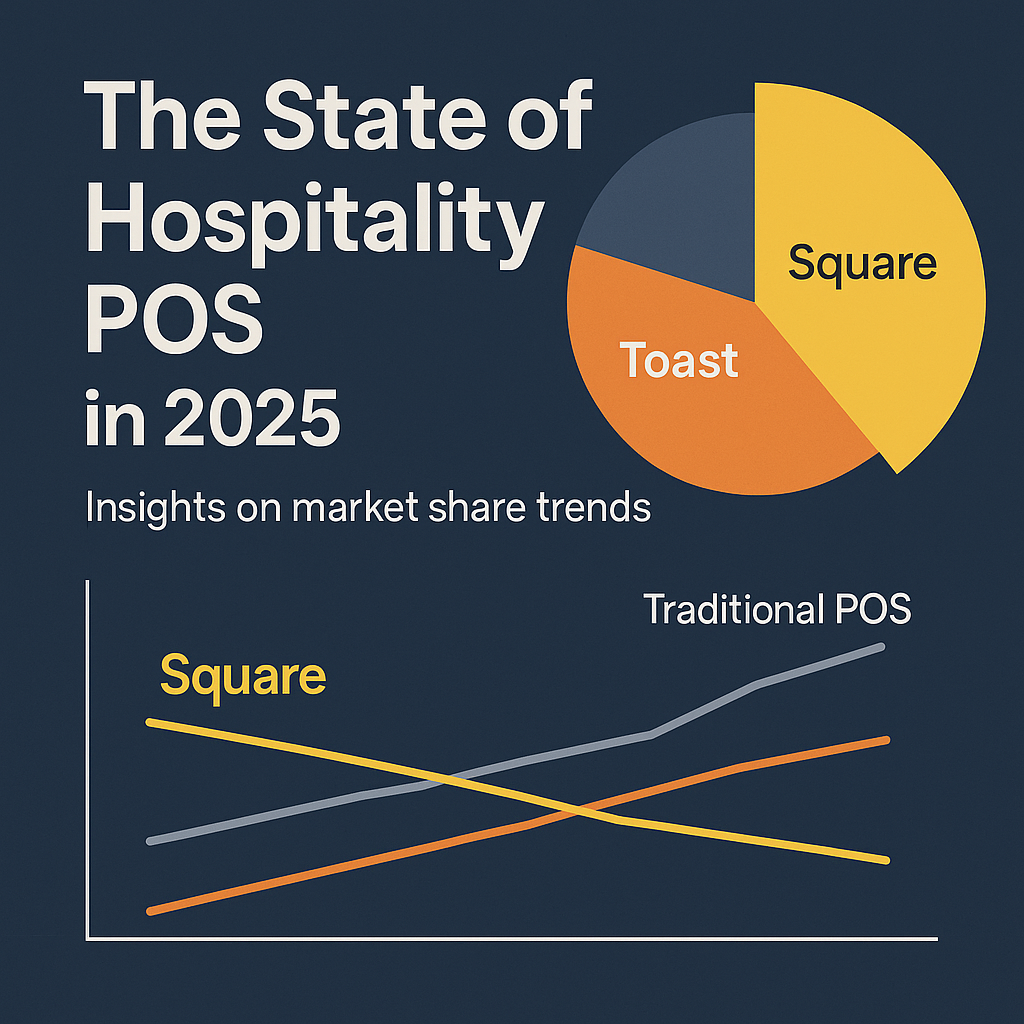
In 2025, the hospitality point-of-sale (POS) landscape is shifting from register-centric systems to operating platforms. Mobile-first fintech brands like Square, restaurant-native platforms like Toast, and traditional enterprise stacks are competing on speed, depth, and total cost of ownership (TCO).
This report distills practical patterns we see across successful operators—who’s winning, where, and why—and how to choose the right path for your concept.
Executive Summary
Square wins on simplicity, speed, and cost—especially for single-unit or small multi-unit QSR/café concepts.
Toast dominates in deep service flows, KDS, delivery integrations, and multi-location operational control.
Traditional enterprise POS still defends complex venues—hotels, gaming, stadiums—where integrations and legacy workflows prevail.
Bottom line: The winner is the platform that fits your unit model, workflow depth, and data/finance posture—not the one with the loudest feature slide.
1. Market Snapshot
Hospitality POS in 2025 is a cloud-first market with mobile and self-service at the edge. Operators now prioritize:
- Faster onboarding (days, not weeks)
- Hardware flexibility (handhelds, tablets, kiosks)
- Omnichannel experiences (dine-in, pickup, delivery, marketplace)
- Data portability and transparent cost visibility
2. Who’s Winning—and Where
2.1 Square (Fintech-First)
- Strengths: time-to-value, clean UI, affordable hardware, lightweight config
- Tradeoffs: limited enterprise-depth controls
- Best fit: cafés, bakeries, food trucks, micro-multi-unit QSR
2.2 Toast (Restaurant-Native)
- Strengths: deep menu & service flows, KDS, delivery & loyalty integrations, multi-unit control
- Tradeoffs: higher TCO, some hardware lock-in risk
- Best fit: full-service, fast-casual with kitchen complexity
2.3 Traditional / Enterprise POS
- Strengths: stability, niche modules (banquets, hotel PMS), proven in large venues
- Tradeoffs: slower upgrades, customization cost
- Best fit: hotels, resorts, casinos, stadiums
3. Architecture Trends in 2025
3.1 Cloud + Offline Resilience
Cloud is now table-stakes—the differentiator is graceful offline support: store-and-forward, queued payments, and conflict resolution.
3.2 Omnichannel & Data Fabric
- Unified menu/catalog powering dine-in, marketplace, delivery, and kiosks
- Two-way sync with inventory, labor, CRM, loyalty, and accounting systems
3.3 Payments Convergence
Tokenized, contactless transactions; settlements & chargebacks linked to order events; revenue recognition tied to channels.
4. Operator Playbook: How to Choose
4.1 Scope First
- Define service model: table, counter, mixed, kiosk
- List integrations you must have on day one
- Decide which analytics can wait until “phase 2”
4.2 Pilot, Then Scale
Run a 2–4 week pilot at one unit. Measure:
- Throughput: orders per staff hour
- Guest experience: queue time, order accuracy
- Ops load: menu change effort, training time
- TCO: subscription + hardware + add-ons
5. Cost & Risk Guardrails
- Negotiate hardware refresh & swap terms up front
- Insist on open data export & API access
- Budget add-ons (loyalty, online ordering, gift, inventory)
- Plan change management—training, playbooks, go-live support
6. Decision Matrix (Quick Guide)
| Context | Recommended Platform | Why |
|---|---|---|
| Single-unit café / QSR | Square | Fast setup, low cost, sufficient depth |
| Fast-casual with KDS & delivery | Toast | Rich kitchen & delivery flows |
| Hotel / Resort / Stadium | Enterprise | Legacy modules, PMS integration |
7. Outlook: 2025–2030
Expect convergence—fintech cost discipline meets restaurant depth and modular hardware. Winners will treat POS as a data platform, not a payments appliance.
Final takeaway: Select for workflow fit and cost clarity. Pilot ruthlessly, expand only after the numbers hold.