
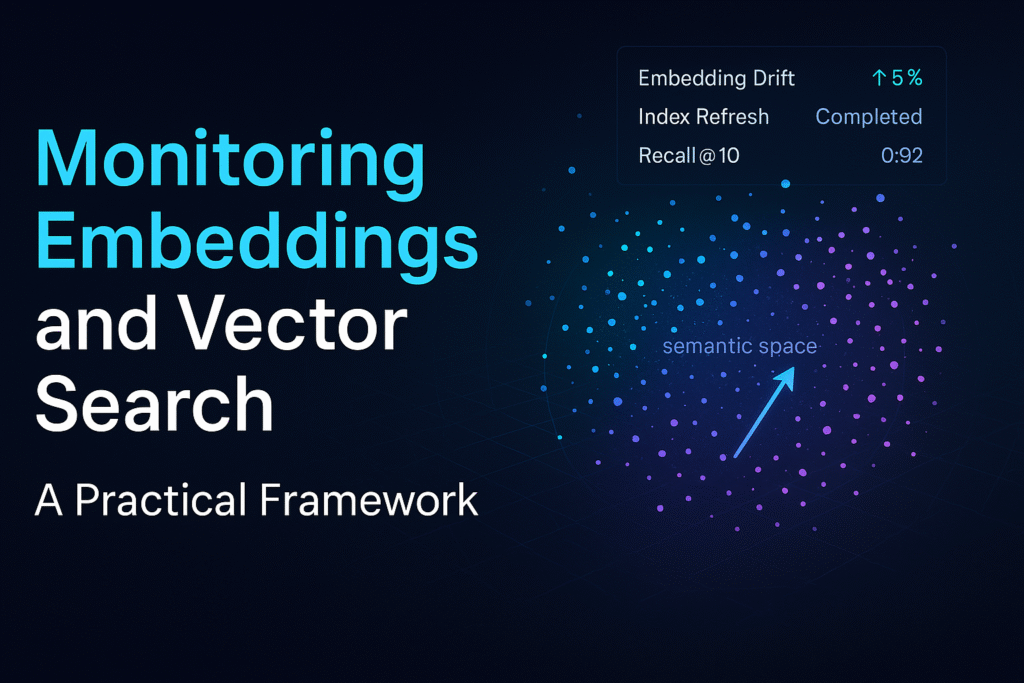
Retrieval quality degrades silently. The culprit is often embeddings and vector search, not the LLM. Here’s a monitoring strategy that catches issues before users do.
Failure modes to expect
- Empty vectors from parsing bugs or timeouts.
- Wrong dimensionality after a model upgrade.
- Drift from new content or revised chunking rules.
- Index corruption or stale HNSW graphs.
Golden queries & labels
Maintain a small, versioned set of “golden” prompts with expected passages and acceptable answers. Run them daily against staging and prod. Alert on recall/precision drops, not just accuracy.
Telemetry to capture
- Per‑query: top‑k passages, similarity scores, source_version, and elapsed time.
- Corpus: embedding completeness %, average chunk age, near‑duplicate rate.
- Index: build times, graph size, memory use, and search latency percentiles.
Rollout policy
Treat an embedding model change like a database migration. Re‑embed a sample, compare retrieval against goldens, backfill in batches, and hold out a canary index. Keep a rollback switch.
Result: You’ll separate model issues from retrieval issues and protect users from silent regressions.