
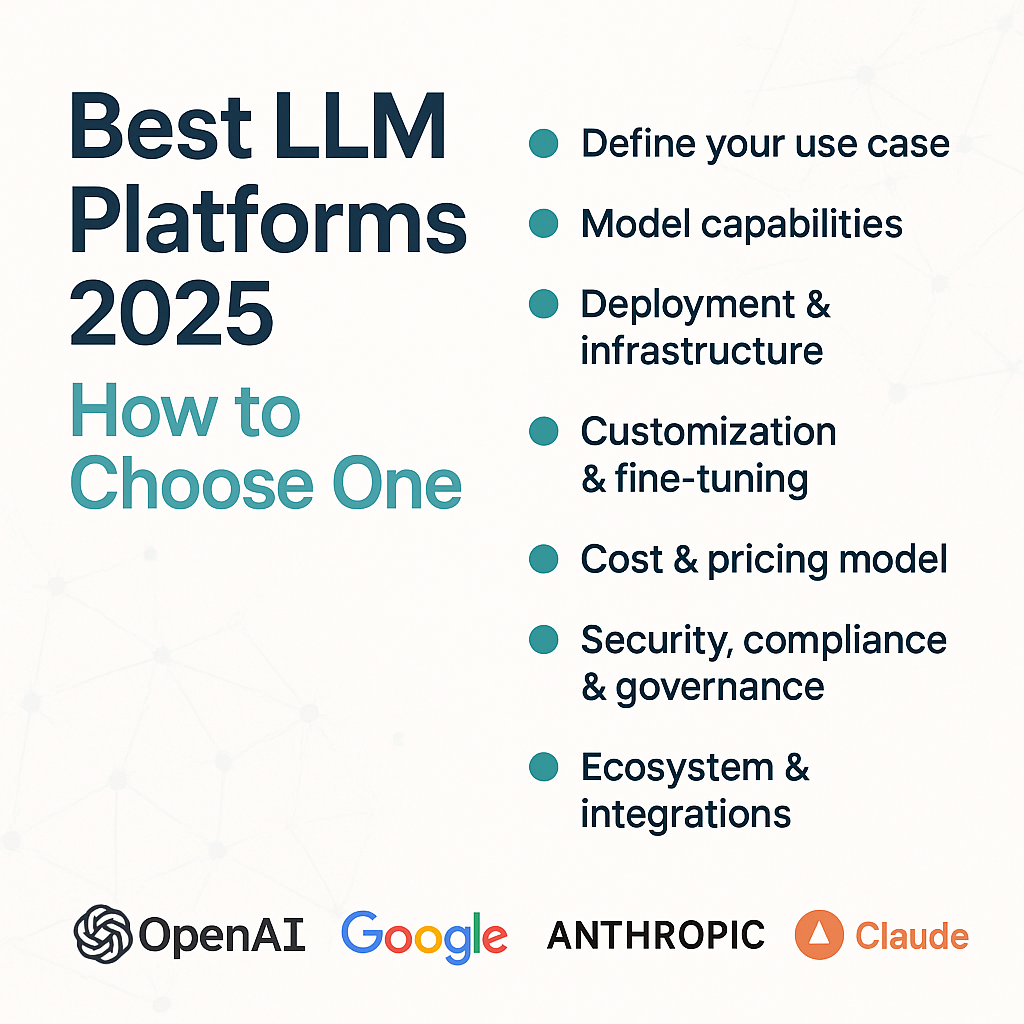
Model performance matters, but platform simplicity and cost control often decide success. This guide outlines a pragmatic stack and guardrails.
Principles
- Build on the data platform your team already operates well.
- Prefer managed inference endpoints for security/compliance; self‑host only when necessary.
- Centralize observability: prompts, context, outputs, costs.
Routing & policy
Start small. Use a fast, inexpensive model for the majority path; escalate on risk/uncertainty. Maintain a policy matrix by task with guardrails (max tokens, allowed tools, PII rules).
Cost controls
- Prompt templates with strict variable slots to enable caching.
- Batching where possible; streaming where responsiveness matters.
- Reject/short‑circuit requests that fail preconditions (missing context, low confidence retrieval).
Security & compliance
Map data flows; classify context sources; enforce tenancy boundaries; redact PII at ingestion and before logging. Keep an audit trail of model and data versions used per outcome.
Proof‑of‑value to production
Pilot for 2–4 weeks on a single, valuable task. Define success thresholds up front (time‑to‑outcome, edit rate, deflection, error cost). If thresholds are met, expand the surface area; if not, retire without regret.
Bottom line: Pick a platform that fits your operating reality and manage costs like a first‑class feature.