
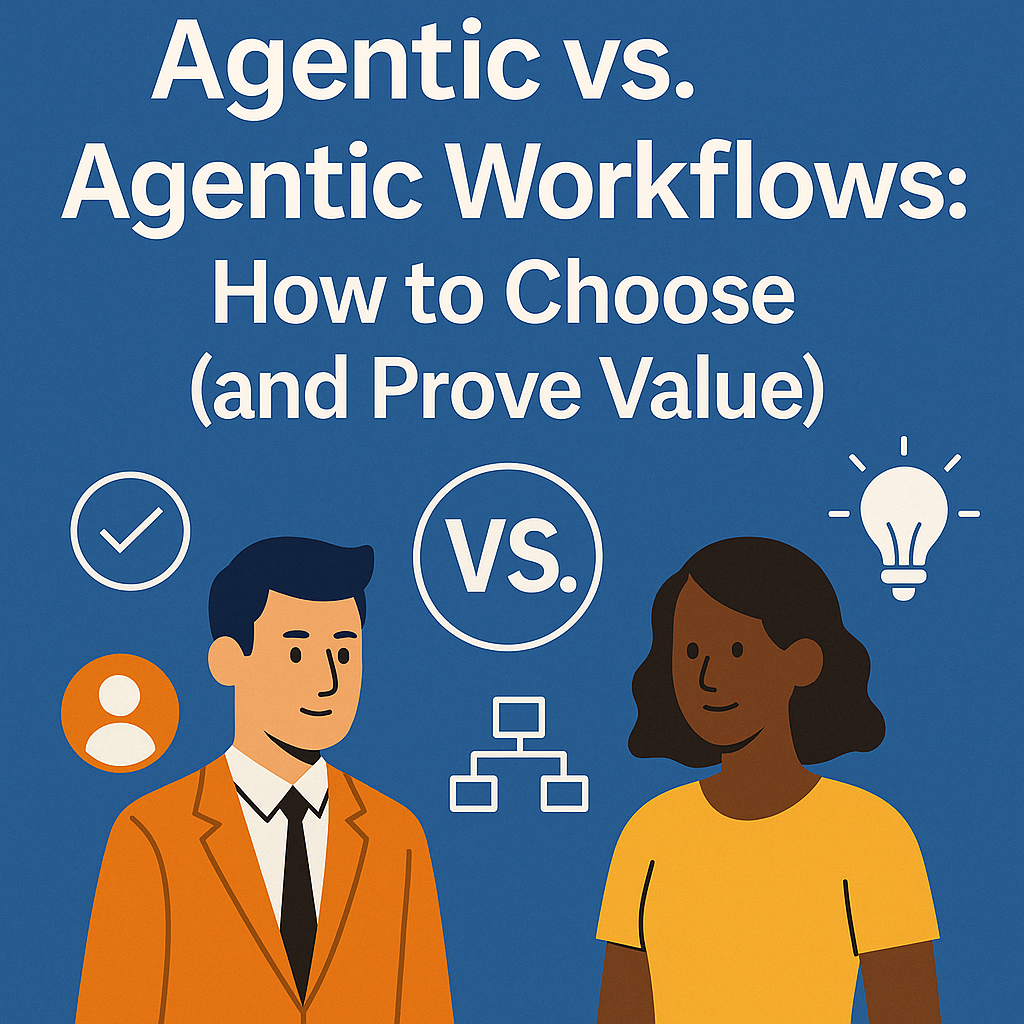
“Agents” and “agentic workflows” are often conflated. In practice they optimize for different things.
Definitions
- Single‑purpose agent: a task specialist with fixed tools and a narrow contract (e.g., “categorize an invoice”).
- Agentic workflow: a composition of small steps coordinated by a planner or rules, with checkpoints and fallbacks (e.g., “investigate a failed data pipeline”).
Design for control, not mystery
Prefer deterministic tools for I/O, and reserve free‑form generation for synthesis. Insert checkpoints: validations, schema checks, and policy rules. If a step fails, surface a helpful artifact to the human (inputs, decision, evidence).
Choosing the right pattern
- Use a single‑purpose agent when inputs/outputs are stable and volume is high.
- Use an agentic workflow when tasks are multi‑step with branching paths, and you need auditability.
Reference architecture
- Router: pick model/tool based on task + risk.
- Planner: expands the task into steps; stores a plan artifact.
- Executor: runs steps with retries and idempotency keys.
- Verifier: checks outputs against rules; escalates if uncertain.
- Journal: logs inputs, steps, tools, outputs, latencies, and token spend.
KPIs
Task success rate, mean time to resolution, average escalations per task, and cost per task. Compare to the manual baseline.
Takeaway: Think like an SRE. The point isn’t autonomy; it’s controllable, observable outcomes.