
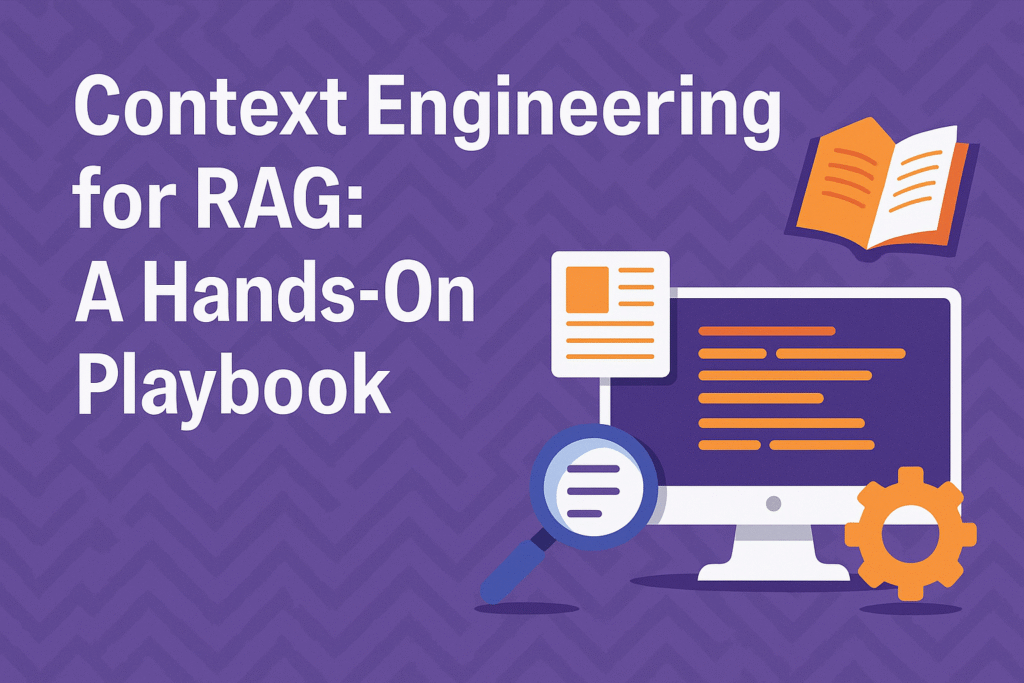
Why context engineering? LLMs are sensitive to the quality and structure of their inputs. Context engineering is the discipline of preparing, optimizing, and governing the corpus that prompts depend on.
1) Model the corpus
Create a content registry: for each source, track owner, review cadence, effective dates, audience, and risk class (public/internal/restricted). Treat missing owners as incidents.
2) Normalize before you vectorize
- Strip boilerplate, navigation, and ads.
- Fix encodings; convert to UTF‑8; flatten weird whitespace.
- Expand abbreviations and resolve product synonyms with a dictionary.
3) Chunk with intent
Chunk boundaries should follow meaning (sections, headers, list items), not arbitrary token counts. Add section_id, parent_id, and effective_date to every record. Avoid orphaned facts.
4) Embedding standards
Pick an embedding model and lock a configuration (dimension, pooling). Every vector row stores: model_version, dim, norm, hash_of_text. Validate: non‑empty, right dimension, finite values, cosine norm within tolerance.
5) Retrieval policies
Define similarity thresholds per use‑case; require diverse sources; de‑duplicate near‑identical chunks; and prefer few, high‑quality passages over noisy floods.
6) Governance & rollbacks
When content updates, invalidate caches and attach the new source_version. Keep a “last known good” snapshot so rollbacks are cheap.
7) Observability
Dashboards: embedding completeness, chunk freshness, top missing topics, retrieval precision/recall (via periodic labeling), and downstream outcome metrics.
Outcome: With a disciplined pipeline you buy three things: lower cost, higher accuracy, and easier compliance.